

Water
Why it matters
Water is essential for steelmaking because large volumes are required as cooling water and process water at the IJmuiden site. The majority of water withdrawn is seawater, which is mainly used for indirect cooling of the Blast Furnaces.
Key objectives
In the double materiality assessment, two negative impacts were identified as material, water withdrawals and water discharges.
TSN is currently developing a new Water Policy and meanwhile continues to monitor withdrawals and discharges in line with permit requirements.
TSN also assessed water use across upstream suppliers through its ESG Strategic Procurement Questionnaire and began exploring water‑saving opportunities, including optimisation of drinking‑water use.
Total water withdrawals continued to be driven by operational conditions, especially cooling demands linked to steel production.
Looking ahead, the Green Steel Project is expected to lower total withdrawals, reduce thermal load and pollutant concentrations in discharges, and substitute freshwater with brackish water and seawater where feasible.
Water is a critical natural resource for ecosystems, communities, and industrial operations. Unsustainable water withdrawal and insufficient control of discharges can contribute to water scarcity and degrade water quality, creating risks for nature, people and business continuity.
Table. Summary of IROs, policies, key actions, metrics and targets related to water
|
Impacts, risks and opportunities |
Category |
Policies |
Key Actions |
Metrics |
Targets |
|
Water withdrawals: In TSN’s steelmaking supply chain, upstream mining activities for raw materials such as iron ore and coal can reduce surface and groundwater availability. TSN’s steel production requires substantial water withdrawals in the form of process water and cooling water, which can disrupt water systems, especially during periods of drought. |
Actual negative impact |
Water Policy |
|
Total water withdrawal |
|
|
Water discharges: In the upstream supply chain, mining, quarrying, and coal operations can discharge used water into water bodies or waterways, potentially leading to adverse environmental impacts. Wastewater discharges from TSN’s operations can affect the quality of receiving water bodies if not effectively managed. |
Actual negative impact |
|
No targets have been set for the current reporting period |
Impact, risk and opportunity management
Water policies
To support responsible water use, TSN started developing a new Water Policy in early 2026, aimed at establishing our commitment to sustainable water withdrawal and discharge and applies across all TSN sites and employees. The policy is guided by the Tata Group's Environmental Policy and the TSN Code of Conduct, which emphasise water stewardship and corporate citizenship. Baseline requirements apply to all sites, while we also monitor water usage and possible improvements for locations assessed to be under water stress. TSN controls water withdrawal and water discharge by applying standards and management frameworks to comply with applicable laws, regulations and permits.
Table. Policies related to water
|
Background |
Key Content |
Scope & key stakeholders |
|
|
|
TSN is committed to achieve sustained reductions in the consumption of high-quality freshwater sources, specifically surface water and drinking water, and therefore deploys targets and implements mprovement programmes. To reduce pressure on freshwater resources, TSN applies the mitigation hierarchy, prioritising the substitution of freshwater with alternative sources – such as seawater, brackish water or groundwater – where this is technically and economically feasible.
We also work to strengthen operational resilience to water-related disruptions and maintain procedures to prevent, respond, and remediate water-related incidents. We drive continuous improvement through periodic review, corrective actions and learning from incidents.
To ensure implementation of the above-mentioned commitments, TSN applies a set of instruments. These include environmental management systems accredited according to ISO 14001, and processes to support compliance with applicable water related laws, regulations and permits. Measurement, monitoring and verification is implemented with defined measurement points and monitoring appropriate to each site’s activities and permit requirements. Where required, TSN applies independent validation, certification or external review.
Recognising the importance of upstream water-related impacts, in line with its commitment under its Supplier Code of Conduct, TSN encourages suppliers to use water responsibly where possible. We engage transparently with stakeholders and collaborate towards support for responsible water stewardship. This collaboration with stakeholders ensures TSN is aware of the impacts not only to our own sites, but to upstream practices where water quantity related environmental impacts may occur.
Water actions
TSIJ utilises water predominantly for its steel production, where it is required as cooling water and process water. In addition to water use for steel production, limited volumes are used for human consumption (drinking water). The water source selected for each use is driven by the water quality and the type of use. Water withdrawals also vary with production levels and prevailing climactic conditions, which influence process water demand and cooling requirements. TSIJ’s principal water sources include seawater (including brackish water), groundwater, surface water and third-party water (drinking water).
-
Seawater: Seawater is predominantly used for cooling purposes, particularly in support of cooling demands within ironmaking operations.
-
Fresh surface water: Surface water is employed across a broad range of process-related activities, including steam generation, cooling systems, gas cleaning, chemical mixing and environmental control measures such as dust suppression. Water recycling often takes place in these processes, for example, in cooling towers. A number of water streams on site are also used at one location before being redirected to a secondary process-step, for example some of the water used for cooling purposes at certain steam boilers (CEN1) is redirected to the demineralisation plant for reuse.
-
Brackish water: Brackish water, which is water that has a higher salt content than freshwater but less than seawater, is used for granulation of slag.
-
Groundwater: Groundwater can be broken into fresh groundwater which is closer to the surface (within 100 metres) and saline groundwater (about 180 metres below the ground surface). At TSN, we only use deep saline groundwater for cooling purposes in non-contact processes.
-
Drinking water: Drinking water is intended for sanitary and facility-related uses, including showers, toilets, office fire prevention systems, and emergency showers.
Since most of the water withdrawals are closely linked to production processes, total withdrawal volumes vary with operational conditions such as operating hours and the specific installations in operation. As a result, operational controls, continuous monitoring and compliance with permit requirements remain central to the responsible management of both water withdrawals and water discharges.
Water current actions
Water withdrawals and discharges in own operations current actions
To strengthen integrated water stewardship, TSN is currently developing a new Water Policy, designed to align practices company‑wide, provide consistent guidance, ensure compliance with environmental and regulatory requirements, and support effective risk management across all operations.
In addition, to enhance site-level water governance at TSIJ, each work unit has appointed a dedicated Single Point of Contact (SPOC) for water management. The SPOC is responsible for overseeing responsible water use within the unit, coordinating the collection and consolidation of water-related information, and serving as the primary contact for identifying and implementing water-saving initiatives.
Additionally, we are investigating the possibilities for water-saving initiatives, including initial exploration of drinking-water optimisation. Current efforts are focused on identifying potential areas for improvement, whereas project implementation is expected in future reporting years.
TSN has concluded that no significant financial resources were allocated to the implementation of its key water-related actions in the reporting period.
Water withdrawals and discharges in our upstream value chain current actions
By issuing our annual ESG Strategic Procurement Questionnaire to suppliers, we are strengthening our insight into the freshwater withdrawals and water discharges associated with our upstream value chain. This process supports more informed decision-making and enhances transparency regarding supplier-related water impacts.
Water future actions
Water withdrawals and discharges in own operations future actions
The Green Steel Project is expected to contribute to improved water performance by lowering total withdrawal volumes, reducing the volume and temperature of water discharges, and decreasing the discharge of harmful substances to surface waters. This expectation is grounded in the findings of the 2025 Environmental Effect Report (MER) for Green Steel, which assesses the environmental effects of the planned process changes. This includes the closure of older installations such as the Blast Furnace 7 and the integration of more efficient designs in new facilities – for example, the use of brackish water for cooling the DRI plant and, where possible, the use of seawater. In addition, TSIJ plans to improve wastewater quality through implementing advanced treatment systems.
The future actions described depend on several external and operational preconditions that may affect TSIJ’s ability to implement them timely and as planned. These are further elaborated on in the Pollution chapter.
The future financial resources expected to be allocated for the implementation of key actions under the Green Steel Project Phase 1 are presented in the Climate change chapter.
Table. Key future actions related to water
|
Key actions |
Scope and timeframe |
Expected outcome |
|
Optimised cooling processes using brackish water for cooling the DRP-EAF plant |
At DRP-EAF by implementation of Green Steel Project |
Reduction in freshwater usage by 8% |
|
Changes to water treatment, cooling and asset closure |
IJmuiden site by implementation of Green Steel Project |
Reduction of thermal load to surface water by ~ 30% |
Water stress
Water stress is the ability, or lack thereof, to meet the human and ecological demand for water, assessed through both the quantity withdrawn relative to renewable supply and the seasonal availability of water relative to consumption. To assess which locations are located in water stress areas, TSN applies global indicators such as tools provided by World Resources Institute (WRI) and the Water Exploitation Index. TSN’s Water Policy applies to all sites located in an area assessed to be of water stress.
While TSIJ is not located in a water stressed area, some downstream entities are. Downstream (TSDE) water use is highly site-specific and dependent on production levels and local conditions. Water withdrawal at TSDE sites accounts for less than 2% of TSN’s total water use. Downstream entities are responsible for efficient water withdrawal and discharge under local management and within applicable requirements. Water withdrawal and discharge are managed locally, with relative priority determined alongside other requirements, while monitoring and reduction efforts are pursued where possible. Tata Steel Maubeuge (France) is one of the downstream entities located in a water stress area. Over the period of 2009 – 2025, a 65% improvement in water consumption performance was realised at Maubeuge due to changes to the treatment of wastewater, changes in total water management and the implementation of adiabatic cooling towers.
Metrics and targets
Water targets
In line with TSN’s ambition to limit its water-related impacts, TSN’s planned actions are closely linked to the Green Steel Project. Through the design of the new installations and associated upgrades, the Green Steel Project is expected to reduce overall water withdrawal, lower both volumes and temperatures of water discharges, and decrease the discharge of harmful substances to surface water. As water metrics are closely related to production processes, these expected changes are of significance to limit the water impact of TSIJ. Further information on Green Steel Project is provided in the Climate change chapter.
Within this broader improvement programme, TSN’s targets focus on reducing the consumption of high-quality freshwater sources, specifically surface water and drinking water. To limit pressure on freshwater resources, TSN applies the mitigation hierarchy, prioritising the substitution of freshwater with alternative sources, such as seawater, brackish water or groundwater, where this is technically and economically feasible. As a result, the planned actions are expected to contribute to an approximately 10% reduction in WRK-water withdrawal at Tata Steel IJmuiden by implementation of the Green Steel Project (Phase 1), alongside a 20% reduction in drinking water use by 2035 compared to the average 2016 – 2019 baseline of total TSIJ drinking water use. These targets are set voluntarily and informed by the priorities set out in TSN’s Water Policy. The metrics in the following section are used to track progress towards target achievement.
Table. Targets related to water
|
Target |
Baseline value |
Target value |
Target year |
Scope |
|
Reduce withdrawal of surface water by ~10% |
34 million m³ per year (2019) |
31 million m³ per year |
20301 |
Tata Steel IJmuiden (TSIJ) |
|
Reduce third-party water by 20% for total water use TSIJ |
415,000 m³ per year (average of 2016-2019) (excluding DE) |
332,000 m³ per year (excluding DE) |
2035 |
Tata Steel IJmuiden (TSIJ) |
Water metrics
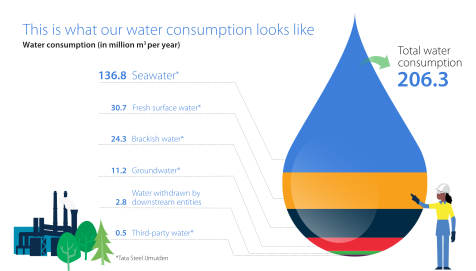
In 2025/26, TSN withdrew 206 million m³ of water from various sources, including downstream entities. Withdrawals were primarily driven by seawater used for indirect cooling of the blast furnaces. Additional sources included brackish water, groundwater, and freshwater. Total water withdrawal decreased by 9.8% compared to 2024/25, mainly driven by a reduction in seawater intake from 159 million m³ to 136.8 million m³. This decrease reflects a combination of factors, including more efficient operation of the blast furnaces following the previous year’s revamp, lower cooling demand due to milder weather conditions, and day‑to‑day operational settings that required less water for cooling. Brackish water withdrawal increased from 23.2 million m³ to 24.3 million m³, which is in line with normal year‑to‑year variability consistent with fluctuations observed in previous years, rather than a structural change in water use. At the same time, groundwater withdrawal decreased from 12.4 million m³ in 2024/25 to 11.2 million m³ in 2025/26, primarily driven by reduced use in the Hot Strip Mill for process purposes, resulting in a decrease of approximately 1 million m³.
TSN has achieved its target to limit surface water withdrawal to 31 million m³ per year, with withdrawals reaching 30.7 million m³ in 2025/26; however, this reflects current operations, and planned dedusting measures for pollution control are expected to increase surface water demand, which may result in higher withdrawal levels in future years. To achieve its third-party water target of 0.332 million m3, TSN has made steady progress and reduced third-party water intake by 0.03 million m3 in 2025/26 compared to 2024/25.
Table. Water metrics
|
Water metrics |
2025/26 |
2024/25 |
|
million m3 |
million m3 |
|
|
Total water withdrawal |
206.3 |
226.7 |
|
Water withdrawn by TSIJ |
203.5 |
226.7 |
|
Thereof seawater |
136.8 |
159 |
|
Therof brackish water |
24.3 |
23.2 |
|
Therof surface water |
30.7 |
31.6 |
|
Therof groundwater |
11.2 |
12.4 |
|
Therof third-party water |
0.47 |
0.50 |
|
Water withdrawn by downstream entities |
2.8 |
- |
|
Total water discharges |
193.1 |
211.8 |
|
Total water consumption |
13.2 |
14.8 |
|
Total water consumption in areas of high-water stress |
0.2 |
- |
Note: Values reported in previous years include only the IJmuiden site, therefore 'water withdrawn by downstream entities'. is not reported in 2024/25. Water use at TSDE locations represents less than 2% of TSN’s total water use in 2025/26. Moreover, water consumption in areas of high water-stress was not monitored in prior reporting years and thus is not reported for 2024/25.
TSN’s total water consumption accounts for 6.4% of TSN's water withdrawal. Consumption mainly results from evaporative losses, such as water vapour released from cooling towers and coke quenching towers.
Beginning this year, TSN is reporting total water consumption for the first time in areas identified as having high water stress. Water consumption in areas of high water stress, while affecting local water resources, is minimal and in FY2025–2026 amounts to 0.2 million m³, which is 1.5% of total water consumed by TSN as a group. This is attributable to the absence of entities with significant water withdrawal activities in such areas.
Accounting policies for water metrics
Methodology, calculation, and data sources
TSN calculates its water metrics using a water balance approach, in which water consumption is derived from total withdrawals minus total discharges. In previous Annual Reports (section "Key figures"), water consumption included the full volume of surface water used in production, as this water is discharged to a different, lower‑quality receiving body (the sea) and therefore not returned to its original source. In 2025/26, water consumption is calculated using a water balance approach (withdrawal minus discharge), meaning that surface water discharged to another water body, namely the sea, is now classified as discharge rather than consumption, resulting in lower reported consumption figures.
The water metrics calculations rely on measured data from each water source including seawater, brackish water, groundwater, surface water and third-party water, supplemented by invoices, meter readings and operational monitoring data. Where direct measurement is not available, TSN applies defined estimation methods, such as assuming full discharge of seawater used for once-through cooling and a small evaporation loss for brackish water. The key limitation relates to permit-based estimates for certain unmetered discharge flows. In addition, for downstream entities, calendar year data is used as a proxy for financial year reporting. From 2025/2026 onwards, the reported metrics include downstream entities, whereas 2024/2025 figures do not include downstream data.
Contextual information
For reporting purposes, TSN water metrics are based on withdrawals from TSIJ and selected downstream entities that were assessed to withdraw significant volumes of water. Entities are included where annual water withdrawal exceeds 50,000 m³; in 2025/2026, this threshold captures approximately 98.77% of total downstream withdrawals. TSIJ alone accounts for approximately 98% of total water withdrawal. The downstream entities included in the reporting scope are
-
Apollo Metals Ltd.
-
Hille & Müller GmbH (Profit Centre Düsseldorf)
-
Société Européenne de Galvanisation (SEGAL) SA
-
Tata Steel Maubeuge SAS
-
Tata Steel Nederland Tubes BV (Zwijndrecht, Oosterhout and Maastricht)
-
Thomas Steel Strip Corp
Water withdrawal in areas of water stress
The following TSDEs are in scope for water consumption in areas of water stress due to their location:
-
Tata Steel Maubeuge SAS, France
-
Societe Europeenne de Galvanisation (SEGAL) SA, Belgium
-
Tata Steel Nederland Tubes BV Oosterhout, Netherlands
-
Tata Steel Nederland Tubes BV Maastricht, Netherlands
To determine sites that source water from areas where water-stress is high, TSN applies the following criteria, whereby a water source is classified as high water stress if any one of the four criteria is met.
-
Assessment of Baseline Water Stress: If the ratio of total annual water withdrawal to total available annual renewable water supply (i.e., ‘water stress’) provided by the WRI Aqueduct is considered High: 40–80% or Extremely High: >80%, TSN classifies the water source to be located in an area at high water stress.
-
Assessment of Water Depletion: If the ratio of water consumption to availability, with thresholds based on frequency and severity (i.e., ‘water depletion’) provided by the WRI Aqueduct is considered greater than High: Seasonal depletion (25-75% for one month/year). TSN classifies the water source to be located in an area at high water stress.
-
Assessment of Baseline Water Depletion: If the ratio of total water consumption to available renewable water supplies (i.e., 'water depletion') provided by the WRI Aqueduct is considered greater than high: 50-75%, TSN classifies the water source to be located in an area at high water stress.
-
Assessment of Water Exploitation: Is based on the ratio of total water consumption as a percentage of the renewable freshwater sources available for a given territory and period. It quantifies how much water is abstracted and how much water is returned to the environment by economic sectors before or after use. Provided by the WEI+, Severe Scarcity: equal or greater than 40%, TSN then classifies the water source to be located in an area at high water stress.
Why water recycling is not reported:
Water recycled or reused is defined as water and wastewater (treated or untreated) that has been used more than once before being discharged from TSN’s boundary, so that water demand is reduced. This may be in the same process (recycled) or in a different process within the same facility (own or shared with other undertakings) or in another of the undertaking’s facilities (reused). At TSIJ, numerous processes ‘reuse’ water by recirculating cooled water by treating the water before reusing it in other processes. The volume of such reused water is not measured. For TSDE, none of the downstream entities have a recycling system in place, therefore this metric is not relevant for TSDE.
Why water stored is not reported:
TSN does not store water for prolonged periods for future use in times of scarcity. At TSIJ, temporary holding bays or 'basins’ collect the incoming brackish and drinking water to pump it onwards to different factories. This is not a storage facility but merely a process to ensure adequate flow rate for various processes. For TSDE, water storage is not relevant because the downstream entities do not retain water.