

Green Steel Project
The second pillar of our SCALE strategy, the Green Steel Project, will help us to maintain steel production in the Netherlands by fundamentally transforming our business. The main goal of the Green Steel Project is to reduce our CO2 and other emissions, while simultaneously improving the environmental and health impact of our operations for the surrounding region (see also Licence to Operate). To achieve this, we will need to invest in cleaner processes, maintenance and innovation. Eventually, the only way forward will be the full transformation of our production processes, which will enable us to sustainably produce cleaner, greener and more circular steel.
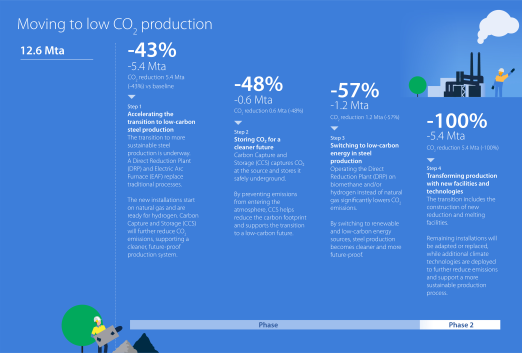
TSN’s blast furnace–basic oxygen route ranks among the more energy efficient globally, with low coal use and CO₂ emissions per ton. But to become net-zero by 2045, we will fundamentally redesign the core of our production processes. This involves transitioning from coal‑based blast furnace technology to cleaner technologies and more sustainable energy sources that structurally eliminate coal from the primary steelmaking route. This transition has been structured into two phases: Phase 1 and Phase 2.
In Phase 1 of our transformation, we plan to construct a Direct Reduced Iron (DRI) plant and an electric arc furnace (EAF). These new installations will replace existing coal‑intensive assets. With the commissioning of the DRI plant and the EAF, one blast furnace and one coke and gas plant will be shut down, marking a major step away from coal‑based steelmaking. The DRI plant will initially operate on natural gas. Once sufficient biomethane and/or hydrogen becomes available at a competitive price, it will transition to a mix of natural gas and/or biomethane and/or hydrogen. Importantly, this transition will not require any technical modifications to the installation. In addition, Carbon Capture and Storage (CCS) will be applied.
“Saying goodbye to coal is the biggest change for our company ever. The process of making steel as we have known it for over 100 years will be completely different.”
Through CCS, the CO₂ emitted from the DRI process is captured and stored underground beneath the seabed, further reducing emissions during the transitional phases. In parallel, we will increase circularity by significantly raising the share of recycled steel through greater use of scrap. As recycling increases, the need for primary raw materials will decrease, resulting in lower direct emissions as well as reduced upstream environmental impacts across the value chain.
In Phase 2, the transformation will be fully completed by shutting down the remaining blast furnace and the remaining coke and gas plant, thereby fully replacing coal‑based steelmaking with the DRI–EAF route.
The switch to net zero steelmaking will most likely be the biggest industrial transition in the Netherlands in the coming years. This takes time, requires permits and many changes at the site in IJmuiden. But we are convinced this is the right way forward, especially in the light of current global geopolitical developments, as it will enable our country to keep its own steel industry. Steel is and remains an essential material in our daily lives and also supports the energy transition. TSN is therefore uniquely positioned to help shape the future of green steel.
Innovation and sustainability
High-quality steel requires continuous innovation. To develop new technologies and keep improving existing products and processes, especially in light of the transition, we use advanced digital technologies. TSN’s Research & Development department runs a long-term innovation programme, which works closely with all other relevant functions to turn initial ideas into actual applications and to ensure that new technologies can be scaled safely and reliably in an industrial environment. We also work extensively with customers and external partners to jointly develop the best possible products and solutions.
Innovation is often data-driven. We use data to help us achieve sustainability goals, such as reducing energy consumption, CO2 emissions and odour, noise and dust nuisance. We also use data for our economic goals, such as improved efficiency (chain optimisation), better quality and the optimal use of energy and raw materials.
Innovation always requires collaboration. TSN pursues a deliberate strategy of collaborating with external partners on fundamental and applied research. In the financial year 2025/26, TSN was connected to approximately 80 PhD and postdoctoral research positions, largely supported through public funding and collaborative programmes. In addition, TSN works closely with a limited number of key research institutes focused on scaling technologies to industrial application, embedded within the same national and international academic networks. A key example of such a collaboration is TSN’s role as a major partner in the ‘Growing with Green Steel’ consortium, funded by the Dutch government through the National Growth Fund. For a period of eight years, this consortium of 30 companies and universities has developed valuable knowledge and expertise with regard to net zero steelmaking.
More detailed information on TSN's transition plan can be found in the Sustainability Statements (Environment – Climate change).