

Remuneration Report
Board of Management (BOM) of Tata Steel Nederland
Remuneration Policy for the Board of Management of Tata Steel Nederland
The remuneration policy of Tata Steel Nederland for the Board of Management is designed to support the Company’s strategic objectives, promote long-term value creation, and ensure a competitive position in the labour market. The policy is fully aligned with Tata Steel’s international reward philosophy and focuses on a consistent, transparent, and responsible remuneration structure.
1 Tata Steel Reward Philosophy
Tata Steel applies a reward philosophy aimed at supporting a diverse and dynamic global organisation. This philosophy fosters a culture of innovation, collaboration, performance orientation, and accountability. The remuneration framework provides market-aligned and competitive employment conditions, complemented by opportunities for professional and personal development.
The Company values and rewards leaders who act in line with its core values of responsible leadership, integrity, and unity. By breaking down organisational boundaries and encouraging collaboration, Tata Steel seeks to embed a culture of excellence that is essential for becoming a leading player in the steel industry. These principles form an integral part of the remuneration policy for the Board of Management of Tata Steel Nederland.
2 Key Principles of the Remuneration Policy
2.1 Market Alignment
Tata Steel Nederland aims to maintain remuneration levels that are aligned with the relevant labour market. Annual or periodic benchmark analyses against a carefully selected peer group within the industrial sector ensure that both fixed and variable components remain competitive.
2.2 Performance-Based Remuneration
The remuneration system is designed in accordance with the principle of pay for performance. Variable remuneration is directly linked to the achievement of predefined financial and non-financial objectives that contribute to sustainable and profitable long-term growth. Target remuneration is composed of approximately:
-
30–40% fixed remuneration, and
-
60–70% variable remuneration.
Non-financial performance criteria include, among others, objectives related to safety, sustainability, leadership behaviour, and collaboration, in line with the Company’s broader reward philosophy.
2.3 Differentiation Based on Role and Performance
The remuneration of individual members of the Board of Management is determined based on their respective responsibilities, required competencies, and performance delivered. In addition, due consideration is given to the collective responsibility of the Board of Management for the execution of Tata Steel Nederland’s strategic direction. The policy reflects the appreciation of leadership that promotes collaboration, safeguards integrity, and strengthens local accountability.
2.4 Stakeholder Balance and Governance
The remuneration policy takes into account the interests of all relevant stakeholders, including employees, customers, and society at large. Tata Steel Nederland follows best practices in corporate governance and applies transparent criteria in determining both financial and non-financial variable remuneration components.
2.5 Remuneration Mix
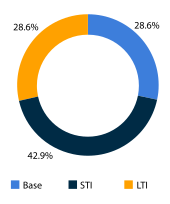
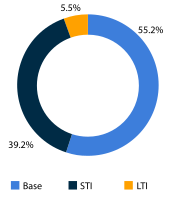
The remuneration mix for the members of the Board of Management consists of fixed remuneration, short-term variable remuneration, and long-term variable remuneration. The charts below illustrate the relative proportions of these components at threshold, target, and maximum performance levels.
On Target
Threshold
Max
3 Key Features of the Short- and Long-Term Incentive Plans
3.1 Short-Term Incentive Plan (STIP)
Annual performance is assessed based on a combination of the following components:
• Global Tata Steel financial objectives (10%)
• Local (TSN) financial, operational, and safety objectives (80%)
• Individual performance (up to 10%)
|
Component |
Incentives |
|
Form of remuneration |
Cash |
|
Financial and non-financial performance criteria |
Financial (60% weighting) and non-financial (40% weighting) |
|
On-target level 90-100% of AP |
100% of base salary |
|
Scenario at threshold or below-threshold performance |
At threshold: 70% of the AP incentive is paid; below threshold: no payout |
|
Scenario at maximum performance 100% + of AP |
150% of the on-target incentive is paid |
|
Individual performance |
A: Excellent Rating 15% |
3.2 Long-Term Incentive Plan (LTIP)
|
Component |
Incentive |
|
Form of remuneration |
Cash as a percentage of Base Salary |
|
On-target level AP achieved |
45% of Base Salary |
|
Financial and non-financial performance criteria |
Financial (70% weighting) and non-financial (30% weighting) |
|
Scenario at below AP level |
Below AP Level: maximum vesting of 10% |
|
Scenario at on-target performance |
Vesting of 45% of Base Salary |
|
Scenario at maximum performance |
Vesting of 100% of Base Salary |
|
Pay-out of LTIP |
Amount due is paid out over a three-year period, 1/3rd per year. 1st payout in July after LTIP is awarded |
4 Base Remuneration Package of the Members of the Board of Management in Office on 1 April 2025
(amounts in thousand euros)
|
Board Member |
Position |
Base Salary |
On-target STI % base salary |
On-target LTI % base salary |
|
Hans van den Berg |
Chief Executive Officer |
630 |
100% |
45% |
|
Akash Latchman |
Chief Operating Officer |
500 |
100% |
45% |
|
Peter Bernscher |
Chief Commercial Officer |
500 |
100% |
45% |
|
Hans Turkesteen |
Chief Financial Officer |
500 |
100% |
n.a.*** |
|
Tom Eussen * |
MD IJmuiden BU |
500 |
100% |
45% |
|
Gunilla Saltin** |
MD Downstream BU |
500 |
100% |
45% |
5 Base Salary
During FY 2026, the base salaries of the members of the Board of Management were not increased with the regular pay review.
The salary of Mr. Akash Latchman was increased with his appointment as Chief Operating Officer for TSN to an amount of €550,000 as per July 2025.
The salary over 2025 for Mr. Hans Turkesteen was increased due to additional responsibilities to €550,000, this was paid retro actively with the payroll of June 2026.
6 Incentive Plan Results
With respect to the FY26 incentive outcomes, while the gate opener for the Performance Bonus (positive consolidated EBITDA) was achieved at both TSN and Group level, the overall KPI achievement (global and local) did not meet the required threshold. As a result, no payment will be made under the FY26 Short‑ Term or Long‑ Term Incentive Plans
7 Discretionary Payment
During the last Financial Year, the Board demonstrated a level of engagement and decision-making that went significantly beyond normal duties, providing intensive oversight and strategic direction under heightened uncertainty and thereby materially supporting the Company’s financial position, operational continuity, and long-term stakeholder interests.
In light of these contributions, a discretionary, long term exceptional award has been established to safeguard the company’s continuity; it falls outside the standard remuneration framework and does not set a precedent for future compensation, but it will be considered annually by the Remuneration Committee .
For FY 26, the amounts awarded are mentioned below, payment will be made with the payroll of July 2026.
Hans van den Berg €110,000
Akash Latchman €110,000
Hans Turkesteen €110,000
Peter Bernscher €50,000
8 Other individual agreements
CFO Hans Turkesteen will receive an amount of €412,500 gross as fixed Long-Term Incentive Payment with the payroll of July 2026. Hans Turkesteen’ s contract will be extended to 1 April 2027. A retention bonus of 75% of Base Pay will be paid if he remains with the company until the end of FY27. This will replace his Long-Term Incentive Plan arrangements for FY27.
COO Akash Latchman has an additional annual engagement payment that pays out in October and is based on his performance. Over FY 26, this is an amount of €45,000 gross paid in October 2026. These payments will continue for FY27 and FY28 and will stop after that date.
CCO Peter Bernscher will continue to receive a monthly housing allowance as well as COO Akash Latchman. This is reported under other Costs.
9 Actual received remuneration of the BOM
(amounts received in thousands of euros)
|
Name current member |
Position |
Base |
Pension benefits |
STI |
LTI |
Social security |
Other compensation |
Total |
|
FY26 |
||||||||
|
Hans van den Berg |
CEO |
630 |
122 |
- |
- |
13 |
139 |
904 |
|
Hans Turkesteen |
CFO |
550 |
125 |
- |
413 |
17 |
141 |
1.245 |
|
Peter Bernscher ****** |
CCO |
292 |
58 |
- |
- |
10 |
134 |
493 |
|
Akash Latchman |
COO |
537 |
134 |
- |
- |
17 |
178 |
867 |
|
Tom Eussen **** |
MD IJM |
250 |
48 |
- |
- |
6 |
33 |
337 |
|
Gunilla Saltin ***** |
MD DS |
176 |
42 |
- |
- |
5 |
47 |
270 |
|
Total |
2.435 |
530 |
- |
413 |
68 |
671 |
4.116 *) |
|
|
*) Former Board members received termination benefit of which the aggregate amount is disclosed in the remuneration note in the Annual Accounts |
||||||||
|
FY25 |
||||||||
|
Hans van den Berg |
CEO |
630 |
122 |
- |
86 |
12 |
33 |
883 |
|
Hans Turkesteen * |
CFO |
292 |
73 |
219 |
145 |
9 |
18 |
756 |
|
Martijn Plaum ** |
CFO |
250 |
48 |
94 |
103 |
8 |
172 |
675 |
|
Akash Latchman *** |
CP&O |
187 |
47 |
- |
- |
6 |
297 |
536 |
|
Tom Eussen **** |
MD IJM |
500 |
96 |
- |
73 |
12 |
44 |
725 |
|
Gunilla Saltin ***** |
MD DS |
500 |
125 |
- |
- |
16 |
444 |
1.085 |
|
Total |
2.358 |
511 |
313 |
409 |
63 |
1.007 |
4.660 |
|
10 Other compensation elements
Other allowances include, among others:
-
Retention package related to termination
-
Discretionary payments
-
Engagement incentive
-
Life insurance premiums
-
Lease allowances
-
Accommodation allowances
-
General Expense allowances
-
Functional Expense allowances